
English source · 7 min
App-owned order and quote workflows
An app can add named review steps to native orders and quote requests. The same order detail, RFQ inbox, HTTP operations, MCP tools, Flow actions, history and transactional outbox remain authoritative. This is a declarative extension; the app does not receive SQL access or replace checkout.
The production-review example adds a quality check before order completion and a technical review before a merchant prepares an offer. Its business vocabulary belongs to the app package.
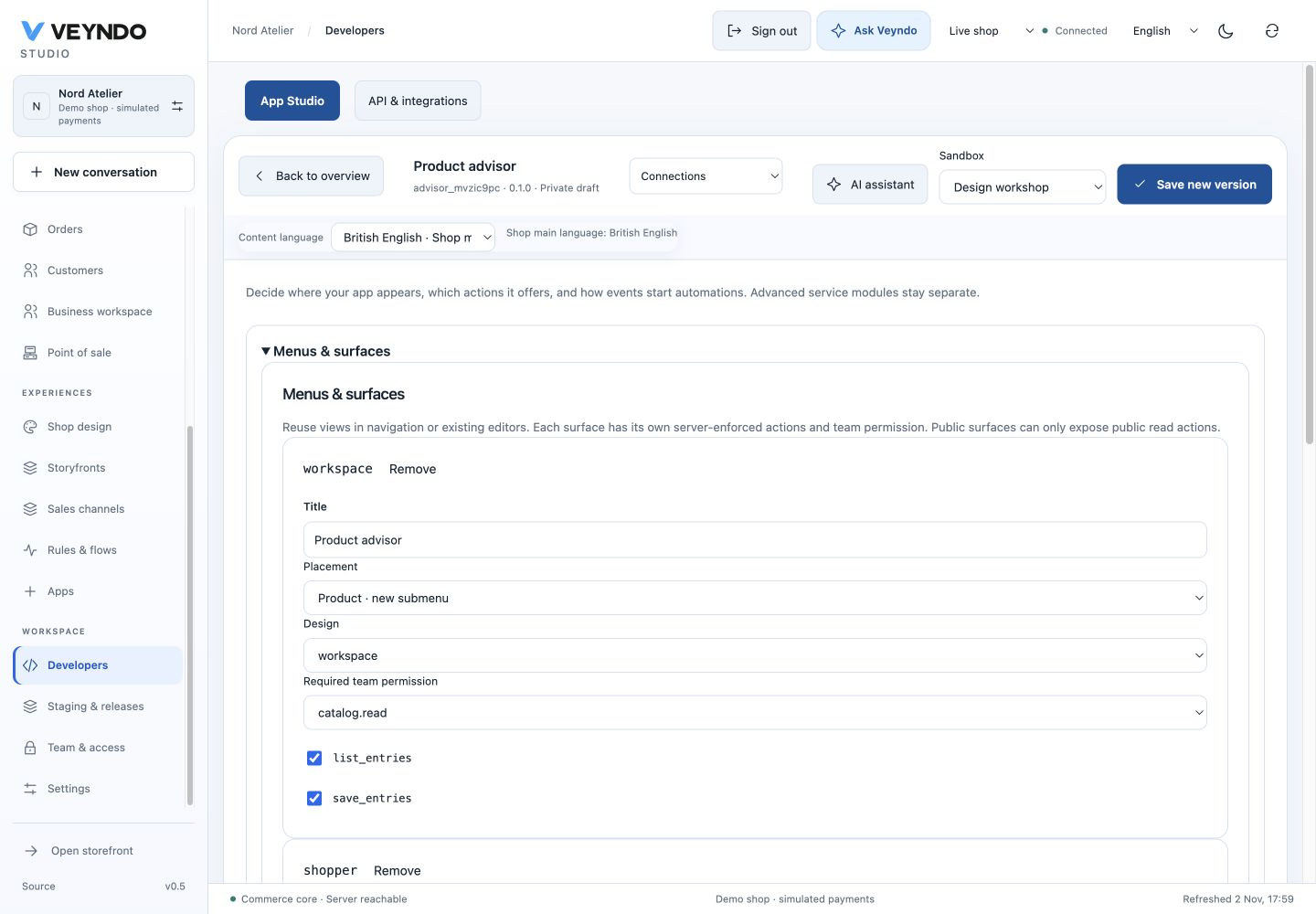
Current interface, 2 November 2026, fictional local shop. Earlier outcome-specific examples below retain their original evidence links.
Build and try a workflow
- Open an app in App Studio → Connections → Order & quote workflows.
- Choose Order or Quote request and add a review workflow. Rename its steps, edit their labels in the selected content language and connect them. Every new state and action needs a label in the shop main language. Both immutable development builds and installation reject incomplete labels; other languages inherit the accepted main-language value. Changing the shop main language or publishing that change also checks active workflow labels. Translate the app first; existing accepted objects retain their original language snapshot.
- For an order, optionally insert a step instead of the native Start processing or Complete order edge. Competing replacements are rejected. Cancellation and financial operations cannot be replaced.
- Select additional current team permissions and supported native checks. These checks can restrict an edge; they cannot approve a native denial.
- Save a new immutable app version, review its permissions and test in a private environment. Publish the selected app package through the normal release review.
- Create a new native order or buyer RFQ. Its next actions appear in the existing order or quote view. Reload after each decision to use its current revision.
Visual edits, agent JSON and exported coding-agent tasks use the same lifecycles
property. The ordinary App Studio assistant can also add a missing order or
quote workflow: describe the review step, required delivery/payment facts and
additional team rights. Its proposal shows the translated paths, guards and
permission scopes before you choose Use this proposal. Installation and
selected publication remain separate explicit steps.
The versioned app-edit@3 prompt advertises this contract and consumes the native context. Previous prompt revisions remain immutable. Existing workflows
cannot be rewritten by a normal AI patch: omitted domains are retained, and
changed existing states, edges or guards reject the entire proposal, including
otherwise valid presentation edits. Use the versioned workflow editor for an
intentional change. Adding the other missing domain preserves the existing one.
The host includes commerce.lifecycle in the candidate's permission review; it
does not grant installation authority or publish anything automatically.
The shared generation schema includes read-only native graph context and the
registered permission names from the same validator. Quote review has no native
replacement edge and supports only the buyer-message guard; order checks remain
payment/delivery facts. Refusals appear inside the assistant, preserving the prompt.


These are unretouched local Chrome captures from 17 October, synthetic order
RAC-5025d580, reference app version 1.0.3. The browser sent the real native
shipment and completion commands. The EUR 24.90 purchase used simulated payment;
the captures are not hosted acceptance or evidence of a real provider charge.
Versions belong to the running object
Each newly created order or RFQ with an active app lifecycle stores a bounded nativeLifecycle snapshot in
its existing operational record. It includes the native machine revision, main
content language, namespaced states/edges and the exact app version and canonical
digest behind each contributed edge. Package rows are locked through object
creation, so an upgrade cannot replace a definition halfway through acceptance.
App installation, manual native workflow edits and selected publication share the
existing configuration fence. A concurrent edit therefore cannot admit a native
base that no longer supports the app's declared replacement edges.
Updating, publishing or deactivating an app affects future objects. Existing objects keep their accepted declarative definition. They still require the actor's current rights and the current native financial/fulfillment checks. This preserves a way to finish work without running removed app code. It deliberately does not retrofit new rules onto historical objects. Orders predating this contract, and new orders without an active order-lifecycle app, retain the existing shop-machine behavior. Ordinary manual shop workflow changes therefore keep their original semantics.
Order activity records the contributed app/version/digest for an accepted
transition. RFQ history and messages preserve the actor, from/to state and source
policy; b2b.quote_changed and native order events use the existing outbox.
Customer projections expose translated state labels and main-language fallback,
not internal app policies or additional permissions. Native directories display
accepted labels even after a package is upgraded or removed.
Contract and safety boundary
Manifest.lifecycles contains at most one version-1 declaration for each of
order and quote. Each permits eight local states and 24 transitions. Local
IDs are at most 16 characters; the host creates stable app-namespaced IDs. All
custom states must be reachable and lead back to a native state. Across active
packages, admission allows eight lifecycle apps, 32 states, 100 edges and at most
60 KiB of serialized machine data. No per-app tables or indexes are created.
Installation requires explicit digest-bound commerce.lifecycle consent,
settings.write, the relevant orders.write or b2b.manage, and every additional
declared transition permission. Native order mutation also requires current
customers.pii, matching its full private response. Quote transitions require
current merchant B2B and PII authority; buyers cannot invoke merchant review steps.
Extra scopes are checked again when an edge is offered and executed.
Missing action authority returns HTTP 403 for both order and quote transitions;
state, guard and stale-revision conflicts return 409.
Version 1 supports these fixed, host-derived facts:
| Order checks | Quote check |
|---|---|
payment.ready: confirmed paid/captured, or explicit simulated authorization |
quote.message: the buyer supplied a nonempty request |
delivery.delivered: every native shipment is delivered |
There is no arbitrary expression, SQL, network request, payment receipt or shell
guard. Order completion still needs native payment and delivery readiness;
cancellation still uses native refund, delivery, inventory and budget rules.
Apps cannot mark quote states as offered, accepted or ordered. A reviewed request
returns to requested; only the existing merchant offer operation creates a
currency/quantity/expiry-bound offer, and only its original buyer/cart may accept.
Native approval, budgets, stock and checkout still decide the eventual purchase.
The extracted native_lifecycle_admissible property proves only that app checks
cannot turn a false native-admission/right/guard input into approval. Snapshot
SQL, membership checks, graph validation, HTTP, UI and deployment require their
own regression evidence. This is not a proof of arbitrary app code.
Verification and delivery
The registered native_lifecycles HTTP/PostgreSQL suite covers real app consent,
orders, native completion denials, stale revisions, foreign shops, current role
changes, MCP completion, pinned old/new versions, conflicting replacements,
invalid financial quote states, real buyer/company/cart RFQs and selected package
publication. A fifth main-language case rejects missing Italian state/action
labels in builds and installation, then creates an Italian-bound native order.
Database-lock interleaving also checks a native workflow edit against concurrent
app installation, including the actual version-bound MCP save operation.
Rust tests add malformed/dead graphs and unsupported guards; UI
tests cover shared compilation, connected editing and regional label fallback.
The registered app_generation provider fixture exercises the ordinary model
HTTP patch through private installation, selected release and a real native
simulated order. Missing delivery blocks completion. The versioned
app-native-workflows.v2.json corpus rejects eight adversarial provider outputs,
including weakened guards/permissions, removed states, identity swaps and an
executable guard, quote replacement and oversized action ID. This tests admission and connected effects with a local model
fixture; it is not an evaluation of a paid model's output quality or a separate
hosted AI acceptance.
Read current status for the deployed image and hosted acceptance. A successful local run or an updated guide does not deploy a runtime. Historical whole-business replay, arbitrary isolated Rust/TypeScript builds and managed service/cell provisioning remain separate parts of the full app programme.
Public acceptance
The 17 October hosted walkthrough records visual creation, immutable versions 0.1.1/0.1.2, private installation, selected publication, two guarded native purchases and the original running order retaining its accepted workflow after the update. Both payments were simulated. RFQ preparation has separate local/required-CI evidence; this is not a hosted RFQ buyer acceptance.