
English source · 8 min
Your business model becomes software
Target: a merchant describes a business capability; Veyndo connects its data, interfaces, decisions, automation and agent access, then makes changes testable, reviewable and maintainable through the existing SaaS release path.
This is the implementation direction adopted on 15 October 2026. It does not claim that managed build/microVM hosting, tenant-wide compatibility replay or automatic canary rollback is already available. The platform hardening programme records the connected prerequisites and their actual implementation state.
Current app-system status maps the proposal to delivered, partial and open behavior, with source owners and dated acceptance. Existing app record lifecycles are distinct from extensible native order/offer state machines.
Executable first slice
The canonical Manifest now accepts optional capability version 1: localized
intent, localized assumptions and up to twelve frozen pure-decision examples.
App Studio exposes an App idea tab in the same editor. Its compact cards show
the declared input, expected money adjustment and acceptance, not fabricated pass
badges. Goal/assumption edits use the existing content-language inheritance and
immutable version save. A package without this field retains its old serialization.
Before a development version is saved or a package is installed, declared examples run through the existing fuel/memory/host-call-bounded WIT component. A trap or mismatch rejects the operation with a JSON Pointer to the case; no package, schema or build is created. Native staging and selected publication use that same installation owner. Existing AI presentation edits preserve the complete contract and its cases rather than rewriting expectations to obtain a pass. Ordinary coding-agent imports can propose explicit new contracts for merchant review.
The snapshot-pricing 1.1.0 package demonstrates five synthetic cases: an empty
cart, two subtotal amounts, zero-decimal JPY and zero-money validation. Its real
checkout still executes native pricing/tax and persists the component outcomes.
The manifest digest covers intent and examples along with code. Example metadata
is not included in public surface projections. Use synthetic inputs only; these
are package fixtures, not an import of customer history or credentials.
This first contract does not claim human-confirmed provenance, a general historical checkout replay, full typed operation generation, native source builds, managed I/O or Commerce Crater. Empty example lists provide no business-behavior verification. Examples test their declared cases; they do not prove arbitrary app correctness. The remaining ordered gates below still apply.
Try the connected path
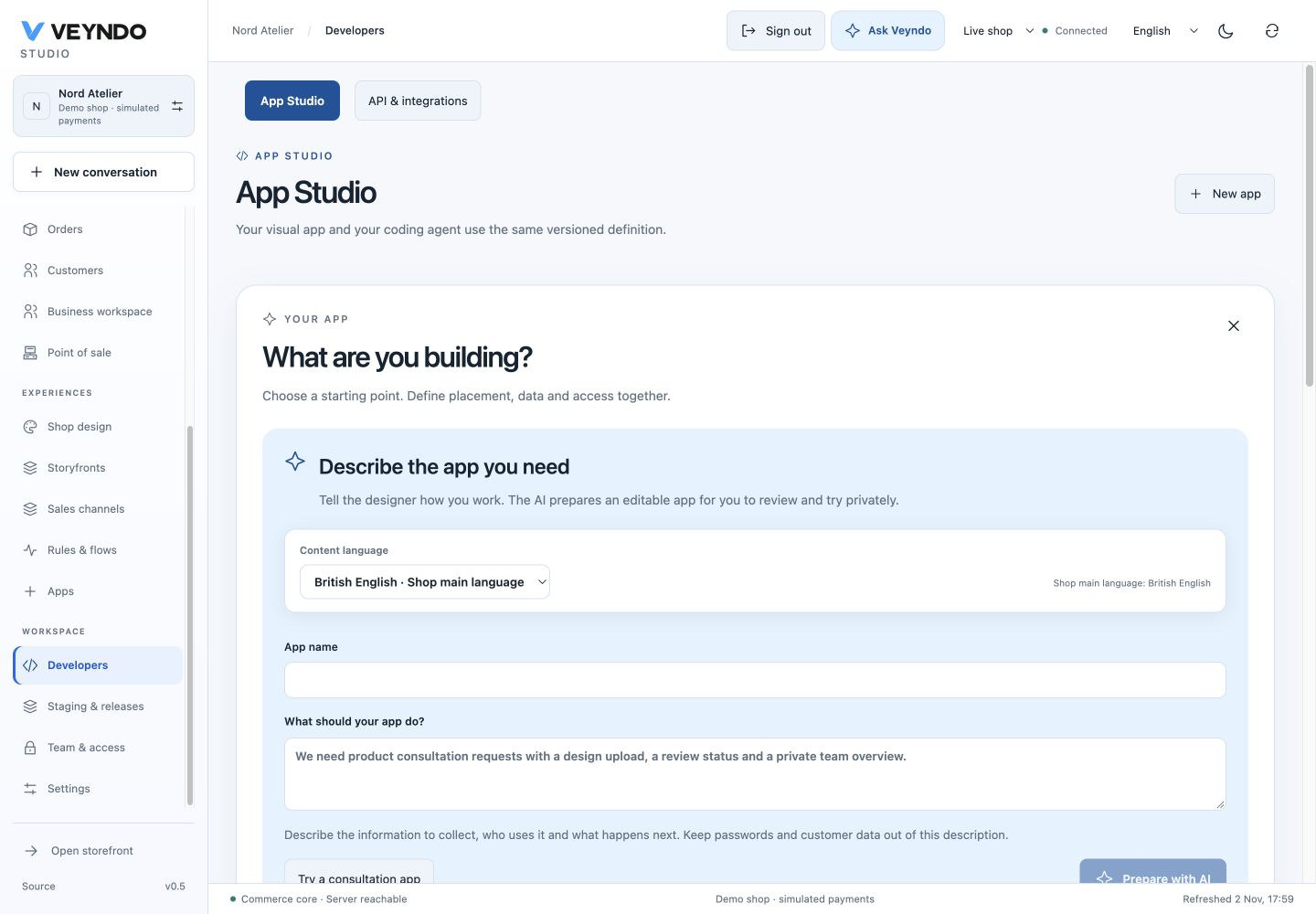
The merchant-facing entry uses plain language: describe an outcome, optionally add requirements, then choose Continue with AI or a coding agent or Design the interface yourself. Three explicit starting ideas help fill the brief. Editing a description does not execute or generate an app by itself.
The assistant opens in the existing drawer with an editable request and the current Manifest, including its requirements. It does not automatically call a model or export a task. The merchant chooses Veyndo AI, Codex or Claude Code and explicitly submits. Codex/Claude prepare the existing task handoff; returned changes still require the normal proposal review. Pending handoffs are bound to app and sandbox, consumed once, and do not replace a prompt belonging to another workspace. When a goal or requirement lacks the shop main language, the brief explains the missing content before saving and offers a direct language switch. It does not copy a translation into another language or weaken native save validation.
Shared agent handoff · Mobile brief


Optional automatic rule checks contains existing frozen pure-decision cases. They are collapsed initially and label stored expectations as expectations, never as successful test results. A display app with no cases is directed to its private preview; absent cases still do not verify business behavior. The rule-check button prepares an agent request, not fabricated fixtures or a replacement executor.
- Open App Studio and edit a package carrying
capability, such as the bundled snapshot-pricing lab. Pure decision packages open their App idea directly. - Choose the content language, edit intent or assumptions and save a new version. These edits use the same immutable Manifest as the visual editor and agent task.
- Review declared synthetic cases. For example, a EUR 100.00 subtotal expects a EUR 1.00 adjustment; JPY uses zero decimal places. Cards show expectations.
- Saving executes those cases through the existing WIT component. A wrong result blocks the save and identifies its case. Passing cases do not prove all inputs.
- Stage and publish through the existing selected-release review. Installation reruns the cases; permissions, package consent and financial invariants remain authoritative. Return to the app overview without losing the selected draft.
The browser acceptance on 15 October saved a translated 1.1.1 development version, restored the draft after reload, opened the shared AI modal without discarding the selected goal and checked 390px mobile containment. HTTP/PostgreSQL cases separately cover wrong expectations, trapped components, immutable build admission, staging, selected release, foreign tenants and actual checkout outcome persistence.
One capability contract
The versioned app Manifest remains authoritative. Extend it with the merchant's intent, assumptions, admitted data/operations, examples, decision contracts, dependencies, migration and failure behavior. The visual editor, coding-agent proposal and API/MCP must edit that same contract. Manual changes keep stable IDs and revisions. App implementation remains within its package owner.
The merchant should see the intended effect and relevant permissions/costs rather than choosing between a plugin, iframe, Wasm module or separate service. Select the weakest supported execution tier. Unsupported requirements must be shown as missing capabilities; never silently turn them into unrestricted service access.
Keep the compact canvas and separate contextual assistant introduced in the workspace update. Conversation is the natural entry to a goal and its proposed changes; the visual designer, data model and code remain available for precise editing rather than being replaced by an oversized chat form.
Decisions with a controlled execution boundary
Pure extension functions consume bounded, revision-bound snapshots and return typed
decisions. Native money, inventory, tax, order, payment and permission owners validate
and execute accepted effects. A generic before/after/replace name is never permission
to replace authentication, settlement proof or another core invariant.
Introduce explicitly versioned domain contracts first for quote/checkout and order transitions. Price contributions have declared phases, deterministic ordering, dependencies and overlap diagnostics. Explanations must cite actual trace facts; a model can phrase the explanation but cannot supply amounts or invariants.
The current Wasmtime dependency is already version 49. A numeric upgrade to “at least 46” is therefore unnecessary. Specific WASI/async/host interfaces, runtime limits and untrusted-code hosting must be verified separately against primary documentation and actual fixtures before being advertised.
Data and lifecycle extensions
Namespaced typed extensions of Product, Customer, Order and Company must use the existing tenant/app data contract and current field-level projections. Their API, MCP, grids, search and knowledge consumers must share admission and schema versions. Public exposure and PII access need explicit consent and current rights; installing an extension never gives direct SQL access to core tables.
Declarative lifecycle extensions reuse existing state-machine, Flow, event and history owners. Pure guards may narrow allowed transitions but cannot waive paid shipping, stock or refund invariants. New business primitives such as period-based rental availability need native domain implementation; a new form is not that feature.
One complete proof case
The furniture configurator now implements a connected local path through native app/B2B/cart/release owners, with frozen positive/negative configuration cases. This is not hosted acceptance of the full concept or historical whole-business replay.
Use a B2B furniture configurator as the acceptance flow:
- Describe materials, special dimensions, surcharge and purchasing approval.
- Review the intended data, storefront configurator, company/account views, production workspace, rules, external handoff and required permissions.
- Confirm positive and negative examples in plain language.
- Run the whole capability in a private preview with simulated external effects.
- Change a dimension rule and review deterministic quote differences and conflicts.
- Publish the compatible package/data change through current sandbox/CAS/release.
- Demonstrate that old orders remain immutable, reorder behavior is explicit, ambiguous external effects remain fenced and a compatible core update preserves confirmed examples.
No illustrative turnover difference, speed claim or compatibility percentage is acceptance evidence. Record actual input revisions, component/package digests, outputs, rejected cases and the verified execution environment.
Compatibility and operating model
Build a “Commerce Crater” check from the existing example-app and reference suites: structural Manifest compatibility, versioned decision ABI, confirmed examples and replay corpora. Start with checked-in packages and synthetic fixtures; evaluating private tenant history requires its original permissions, retention and privacy boundary. A failure creates a reviewable repair proposal, not an unapproved migration.
Code rollback does not reverse email, payment, shipping or other external effects. Canary publication must preserve deterministic cart/order version binding and explicit uncertainty; it is additional work beyond the current selective release.
Managed source builds and services require a real isolated execution owner without production secrets, digest-pinned artifacts, capability-limited egress, budgets and observability. MicroVM/platform services, tariff quotas and cell relocation must not be represented by a Dockerfile or UI label alone. Existing private Storyfront and Payments product boundaries remain intact.
Ordered implementation gates
| Gate | Required user-visible outcome |
|---|---|
| Contracts and decisions | Existing pricing/message/engraving examples use typed versioned decision artifacts and repeat the same frozen quote inputs deterministically. |
| Complete B2B capability | The configurator works across shop, account, administration, approval, reorder, revisioned change and native release, with trace-based explanation. |
| Operated individual software | A supported source build, guarded service runtime and core compatibility check work through their actual production consumer. |
Original Shopware app/script execution and PHP-plugin translation are parked on
experiment/shopware-compatibility.
They are separate from these main-platform gates. Inward shop-data migration and
native original-PHP calculation comparisons remain available. Third-party hosting
claims still need their own runtime acceptance. The product is a publicly developed
experiment platform under the Sustainable Use License, not an
assertion of production completeness or guaranteed maintenance for every extension.
App idea usability check — 16 October 2026
The UI follow-up retains the canonical intent/assumptions/examples fields and native immutable save/preview/release owners. Browser acceptance uses a synthetic local shop: choose a product-advice brief, add a private-team requirement, open the shared assistant, explicitly prepare a real Codex task, return to the visual editor, and save the goal/requirement in a new private version. A reload retains both. The mobile brief remains inside its 390 px viewport. No paid model call or public publication is implied by this UI acceptance.
The 583 frontend tests include no automatic execution on handoff, rejection of a
seed from another app/stage, regional content edits, optional-check disclosure and
preservation of frozen cases. Production TypeScript/Vite build, localization and
ownership checks pass. The registered native app_generation suite uses a synthetic
model HTTP fixture to exercise immutable drafts, real private preview, explicit
staging and rejected unsafe model changes. It is not a real-model quality test.